The From-Scratch Math: Does Homemade Greek Yogurt Actually Save Money?
The From-Scratch Math: Is Homemade Greek Yogurt Cheaper?
Grocery prices keep going up.
I know I’m not the only one who feels it. I can walk into the grocery store, buy what feels like a pretty ordinary cart of food, and somehow spend far more than I expected.
At the same time, it often feels like we’re paying more for food that isn’t necessarily getting better.
As a mom feeding a big family, that’s had me thinking a lot lately about the way I shop and cook.
I already make quite a few things from scratch, and I’d like to make even more. Partly because I like knowing what’s in the food I’m feeding my family. Partly because I enjoy making things myself.
But there’s another question I’ve started asking:
Does making it from scratch actually save money?
Because if I’m going to spend extra time making something I could easily grab at the grocery store, I want to know whether that extra effort is doing anything for our grocery budget, too.
So I decided to stop guessing and start doing the math.
Welcome to The From-Scratch Math, where I’m figuring out which foods are actually worth making at home.
Along the way, I’m giving myself a challenge:
Can I save $1,000 a year by making the right foods from scratch?
I’m not just looking at whether homemade is technically cheaper. I want to know how much it saves, how much hands-on work it takes, whether my family likes it, and ultimately whether I’d actually make it again.
Not every recipe will move us closer to the goal. Some may save only a few cents. Others may cost about the same but give us better ingredients or better flavor. And I fully expect to find a few things that simply aren’t worth making at home.
The point isn’t to prove that homemade is always better or cheaper. It’s to do the math honestly and discover which from-scratch swaps actually make sense for our family.
First up: Greek yogurt.
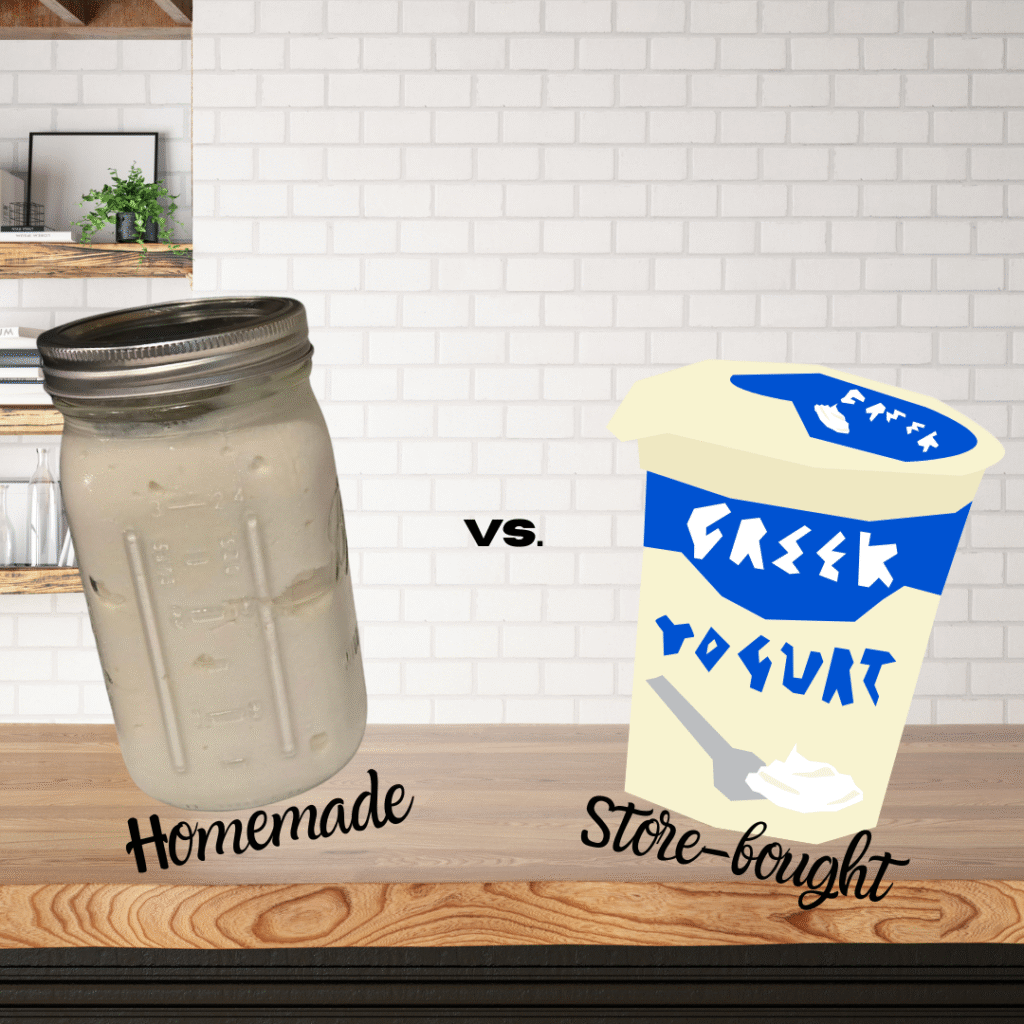
The From-Scratch Math Philosophy
I don’t make everything from scratch because it’s always cheaper. I make it because I want to know when it’s worth it.
Sometimes homemade saves us money. Sometimes it simply lets us use better ingredients for about the same price. This series is about looking honestly at cost, time, taste, and real family life—so we can decide what is truly worth making at home.
Why I Tried Making Greek Yogurt
Greek yogurt is a staple in our house.
My kids like it, it’s an easy breakfast or snack, and we go through a surprising amount of it. Conservatively, I’d estimate that we buy about four 32-ounce containers every two weeks — sometimes more, especially when the kids are eating flavored yogurt.
Usually, I buy store-brand whole milk Greek yogurt. But when the store brand is out of stock, I’m left buying a more expensive name-brand version.
So yogurt seemed like a pretty good place to start experimenting.
What I Normally Buy
For this comparison, I don’t want to compare my homemade yogurt to the most expensive yogurt I can find just to make the homemade version look better.
I want to compare it to what I would actually buy.
At Walmart, the Bettergoods whole milk Greek yogurt is $3.93 for 32 ounces. Food Lion’s store brand is almost identical at $3.99 for 32 ounces.
When those aren’t available, though, the price jumps.
| Greek Yogurt | 32-oz Price | Cost Per Ounce |
|---|---|---|
| Walmart Bettergoods | $3.93 | 12.3¢ |
| Food Lion store brand | $3.99 | 12.5¢ |
| Food Lion Cabot | $5.29 | 16.5¢ |
| Walmart Chobani | $5.97 | 18.7¢ |
Since I normally try to buy store brand, I’m going to use the cheaper Walmart yogurt — 12.3¢ per ounce — as my main comparison.
The From-Scratch Math
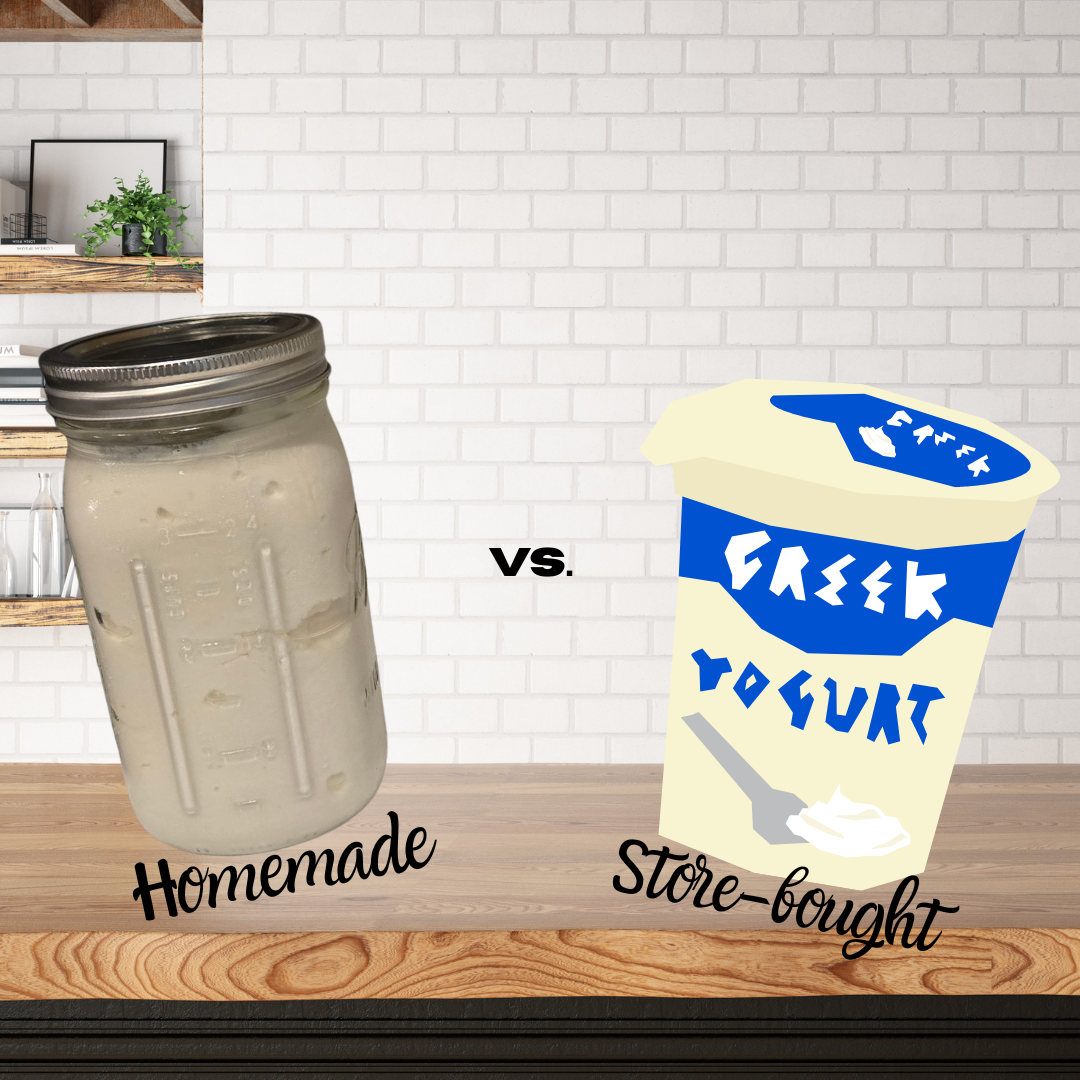
My homemade version is almost ridiculously simple.
I use:
- 1 gallon whole milk
- A small amount of plain yogurt with live active cultures as a starter
My husband found a gallon of whole milk at Lowe’s Foods for $2.29.
After culturing and straining it into Greek yogurt, I ended up with approximately 70 ounces of finished yogurt.
Full disclosure: that’s an estimate because my family started eating it before I remembered that I needed to weigh it.
Apparently I need a “Mom is doing math for the blog — don’t eat this yet” sign for the refrigerator.
For my first batch, I used yogurt I already had in the refrigerator as my starter. If I were starting without any yogurt on hand, I’d probably buy a single-serving container for around $1.
After that, though, I can simply reserve a little yogurt from one batch to culture the next.
So here’s the math for a normal ongoing batch:
| Homemade Ingredient | Cost |
|---|---|
| 1 gallon whole milk | $2.29 |
| Starter from previous batch | $0 |
| Total batch cost | $2.29 |
| Approximate finished yogurt | 70 oz |
| Cost per ounce | 3.3¢ |
If I had to purchase a $1 starter yogurt, that first batch would cost $3.29 total, or about 4.7¢ per ounce.
Either way, homemade wins pretty decisively.
Homemade vs. Store-Bought
Now for my favorite part: putting the numbers next to each other.
| Store-Bought | Homemade | |
|---|---|---|
| Finished amount | approx. 70 oz | approx. 70 oz |
| Cost per ounce | 12.3¢ | 3.3¢ |
| Cost for approx. 70 oz | $8.60 | $2.29 |
| Savings per batch | — | $6.31 |
| Percent cheaper | — | about 73% |
And remember: I’m comparing homemade yogurt to the inexpensive store-brand yogurt I normally buy.
If I compared it to Chobani or Cabot, the savings would be even larger.
But What Does That Actually Save My Family?
This is the number I really wanted to know.
Saving nine cents per ounce doesn’t sound particularly life-changing.
But we’re a family of six, and we eat a lot of yogurt.
If we conservatively go through four 32-ounce tubs every two weeks, that’s:
128 ounces every two weeks.
Over a year, that’s approximately 3,328 ounces of Greek yogurt.
At 12.3¢ per ounce for the Walmart store brand, that’s roughly:
$409 per year.
At my homemade cost of about 3¢ per ounce:
$109 per year.
Potential annual savings: approximately $300.
From yogurt alone.
That’s the kind of grocery savings I’m interested in.
I’m not looking to spend an hour making something from scratch to save 37 cents.
But if a relatively simple change could keep almost $300 a year in our grocery budget?
I’ll pay attention to that.
But What About My Time?
This is going to be an important part of The From-Scratch Math because cheaper doesn’t automatically mean worthwhile.
My time has value, too.
And this is where yogurt scores particularly well.
The entire process takes quite a while, but the hands-on time is minimal.
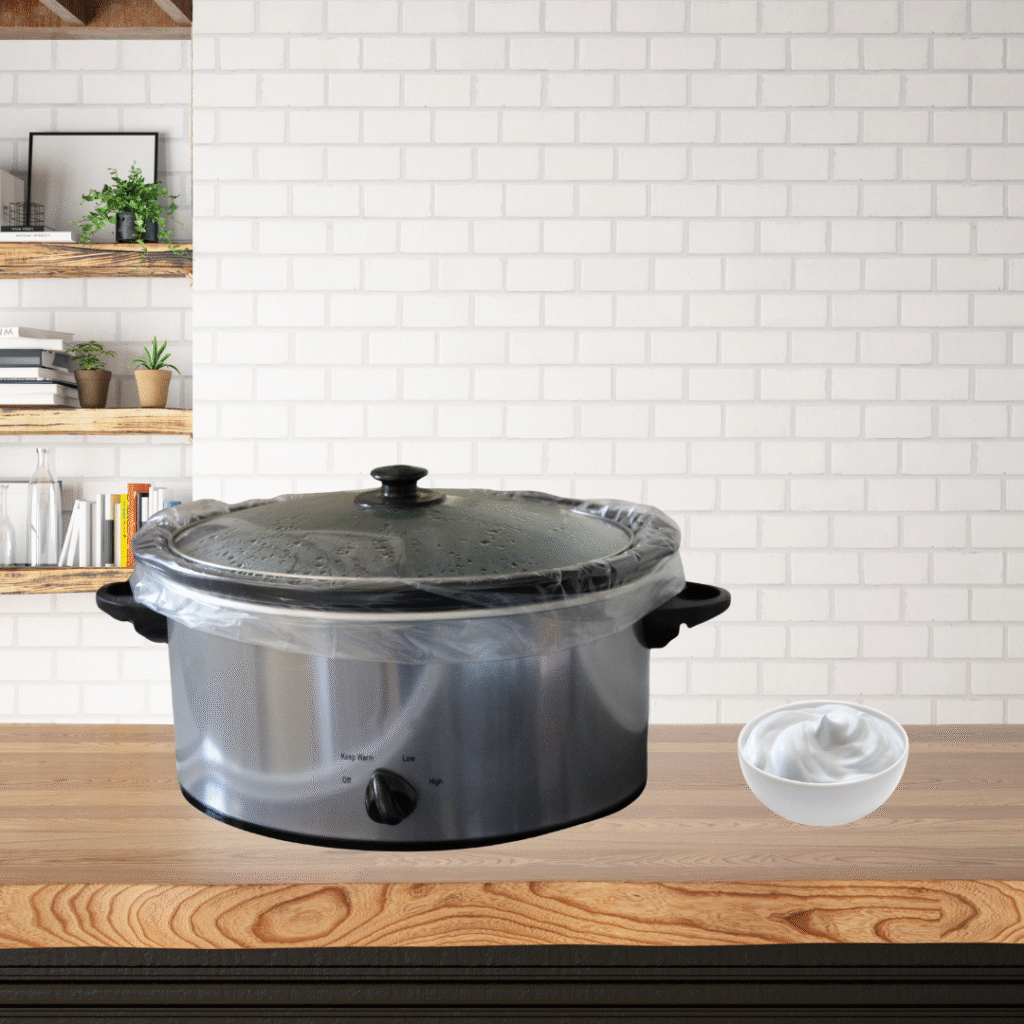
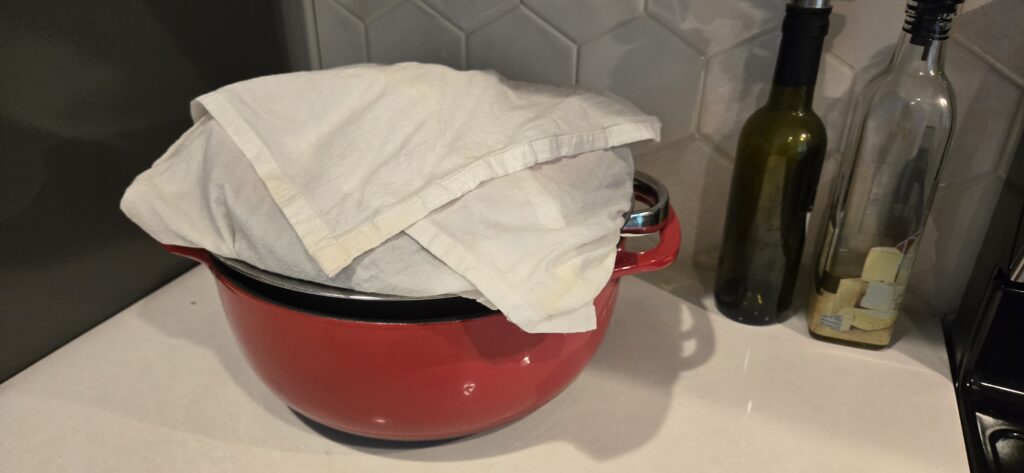
I heat the milk and let it cool. Once it reaches the right temperature, I add the starter, wrap it up and leave it overnight.
In the morning, I put the yogurt into a colander lined with flour-sack cloth and let it drain for most of the day.
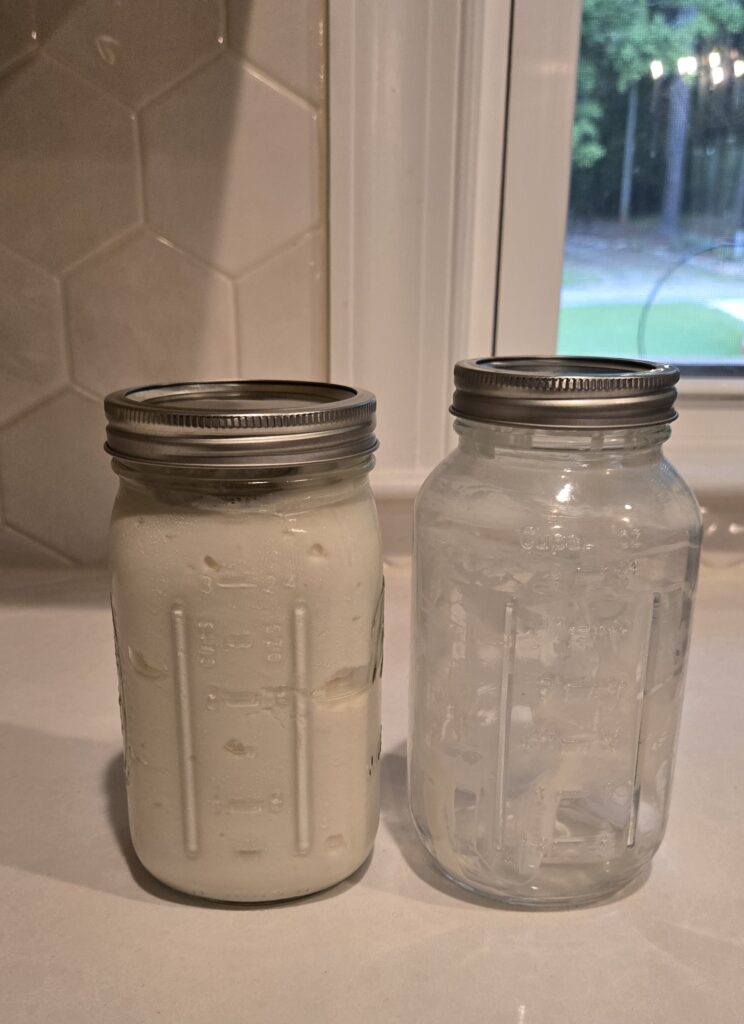
Then I transfer the finished Greek yogurt into mason jars and put it in the refrigerator.
That’s it.
Most of the “work” is actually just waiting.
| Time & Effort | Homemade Yogurt |
|---|---|
| Hands-on time | Minimal |
| Total process | Overnight + straining |
| Difficulty | Easy |
| Special equipment | None beyond basic kitchen supplies |
| Make-ahead friendly | Very |
For me, that’s an important distinction.
Something that takes eight hours from beginning to end isn’t necessarily an eight-hour job.
Beyond the Price
Money isn’t my only reason for wanting to make more of our food from scratch.
I also want more control over what goes into the food I’m feeding my family.
Homemade yogurt is about as simple as it gets: milk and live cultures.
From there, we can make it whatever we want.
We can eat it plain, add fruit, drizzle in honey or maple syrup, mix in homemade jam, add granola, or use it in smoothies and recipes.
And since my kids already like yogurt, this isn’t a case of saving money by replacing something they love with something they’ll begrudgingly eat.
They’re already eating the homemade version.
In fact, they started eating my test batch before I could weigh it.
I’d call that family approval.
The From-Scratch Verdict
| Verdict | |
|---|---|
| 💰 Money saved | ⭐⭐⭐⭐⭐ |
| ⏱️ Effort required | ⭐☆☆☆☆ |
| 🥣 Taste | ⭐⭐⭐⭐⭐ |
| 🌿 Ingredient control | ⭐⭐⭐⭐⭐ |
| 👨👩👧👦 Family approval | ⭐⭐⭐⭐⭐ |
| Would I make it again? | Absolutely. |
VERDICT: ABSOLUTELY MAKE IT
For our family, homemade Greek yogurt is an easy win.
It costs about 70% less than the inexpensive store-brand yogurt I’d normally buy, requires very little hands-on work, gives me complete control over the ingredients, and my family happily eats it.
This is exactly the kind of from-scratch swap I’m looking for.
The $1,000 From-Scratch Challenge
Because I’m curious about what all these individual changes could add up to over a year, I’m setting a goal:
Save $1,000 a year by making the foods that are genuinely worth making from scratch.
This isn’t a promise that every homemade recipe will save money. Some may give us better ingredients for roughly the same cost. Some may taste wonderful but require more work than I’m willing to do regularly. And sooner or later, I’m sure we’ll find something that makes me say, “Nope. I’m buying that.”
But when a simple swap does save money, I’m adding those savings to the running total.
| From-Scratch Swap | Potential Annual Savings |
|---|---|
| Greek yogurt | $300 |
| Running Total | $300/year |
Challenge Progress
$300 of $1,000
30% of the way to our goal after just one experiment.
That is a much stronger start than I expected.
Now I’m curious what will happen when I do the math on bread, granola, pizza dough, pancake mix, chicken nuggets, tortillas, and everything else we regularly buy.
Some will probably be big wins.
Some may barely move the total.
Others might give us better food without meaningfully changing the budget.
Because feeding a family well on a budget isn’t about making absolutely everything from scratch.
It’s about figuring out which things are worth making, which things are worth buying, and where a little extra effort can make our grocery money stretch further.
And that’s exactly what I intend to find out.
One batch—and one honest calculation—at a time.